
The invisible poverty of our time
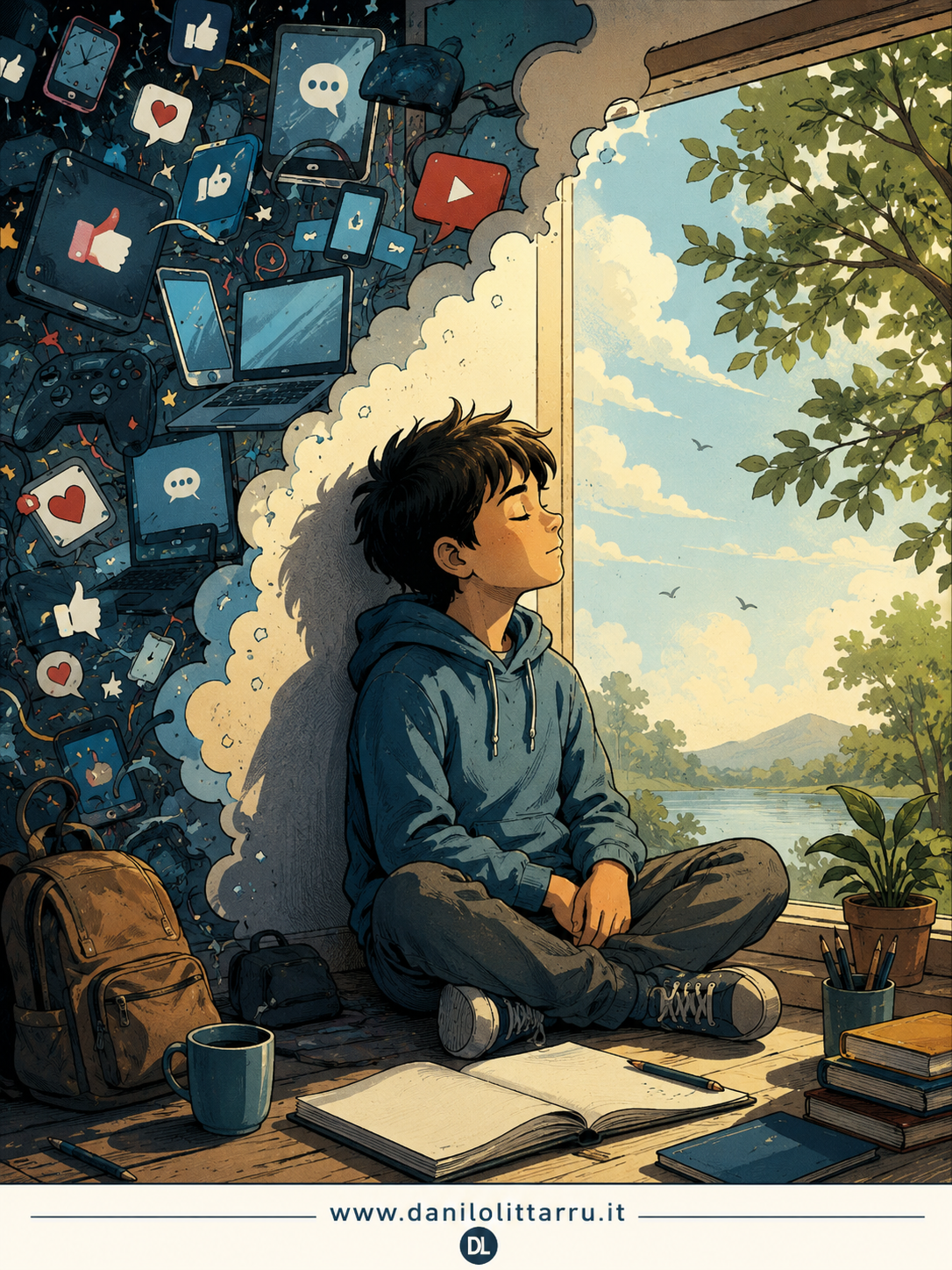
There is a form of poverty that does not appear in economic reports, is not measured by statistical agencies, and rarely occupies newspaper headlines. It is the poverty of silence.
Contemporary society is witnessing an unprecedented anthropological transformation: the gradual disappearance of empty spaces within human experience. This is not simply a matter of increasing noise or the growing presence of digital technologies. The phenomenon runs much deeper and concerns the very ability of human beings to inhabit silence, embrace solitude, and cultivate an authentic dialogue with their inner world.
The question that educators, psychologists, parents, and teachers should be asking is not how much time young people spend in front of a screen, but rather what happens to the mind when every pause is filled, every moment of waiting is eliminated, and every void is immediately anesthetized.
Silence as a lost educational experience
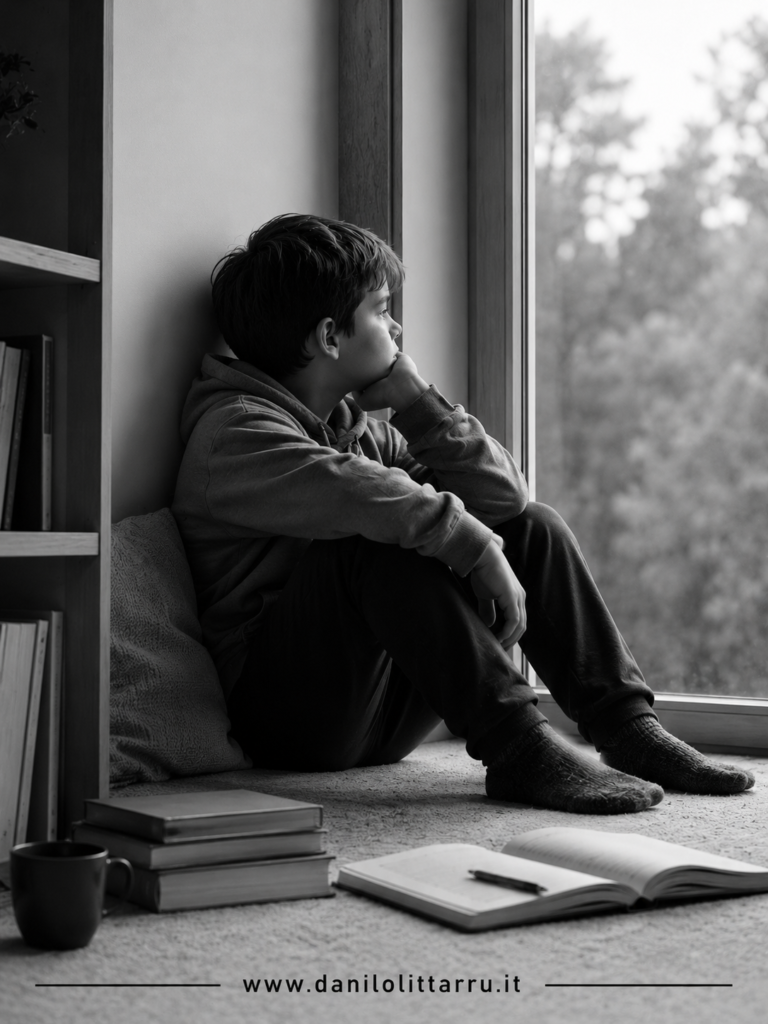
A child growing up in the 1980s or 1990s encountered silence on a daily basis. They experienced it during long afternoons with few stimuli, while waiting, during journeys, in moments of boredom, and even while gazing out of a window observing the world.
Today, by contrast, a child or adolescent can go through an entire day without experiencing even a few minutes of genuine absence of stimulation. Smartphones, video games, social media platforms, on-demand content, and endless notifications occupy every interstice of existence.
Boredom has become a problem to eliminate rather than an experience to be traversed.
Yet it is precisely during these seemingly unproductive moments that the brain performs some of its most sophisticated functions.
The neuroscience of silence: when the brain is truly working
Modern neuroscience has identified a neural network known as the Default Mode Network (DMN), which becomes particularly active during states of mental rest and spontaneous reflection.
Contrary to popular belief, when the mind appears to be doing nothing, the brain is engaged in highly complex activities:
- memory consolidation;
- integration of lived experiences;
- construction of personal identity;
- emotional processing;
- development of creativity;
- future planning.
In other words, when the brain wanders, the human being constructs the self.
Continuous exposure to digital stimulation risks interrupting these processes, generating a form of “cognitive colonization” of the inner world.
The tyranny of continuous stimulation
We live in a culture that regards emptiness as a threat.
Every moment must be productive. Every pause must be occupied. Every waiting period must be eliminated.
This mindset has transformed silence into an anomaly and contemplation into a waste of time.
The philosopher Byung-Chul Han has described our era as a society of performance, in which individuals are constantly compelled to produce, consume, communicate, and react.
The consequence is a gradual erosion of contemplative life.
We are no longer trained to be with ourselves.
We are trained to distract ourselves from ourselves.
Boredom as a training ground for creativity
One of the most widespread educational misconceptions is the belief that boredom is a negative experience.
In reality, boredom represents an extraordinary developmental laboratory.
When a child is not provided with external stimuli, they are compelled to generate inner images, invent games, construct narratives, and formulate questions.
Creativity almost always emerges from an empty space.
History’s greatest scientific, artistic, and philosophical insights did not arise during moments of hyperstimulation, but during periods of reflection, contemplation, and apparent inactivity.
To deprive young people of boredom is to deprive them of one of the essential tools for developing imagination, autonomy, and divergent thinking.
Adolescence and identity formation: the risk of permanent noise
Adolescence is the stage of life in which individuals are called to answer a fundamental question:
“Who am I?”
This question requires silence.
It requires introspection.
It requires the ability to remain with one’s emotions without immediately seeking distraction.
When every discomfort is covered by a video, a chat, or digital content, the risk is that young people become increasingly familiar with the external world while growing progressively estranged from their inner one.
Many adolescents today possess extensive knowledge of global trends, yet struggle to recognize their deepest emotions.
The forgotten lesson of philosophy
For centuries, philosophers, mystics, and educators have attributed a central role to silence in human development.
Martin Heidegger regarded profound boredom as one of the fundamental experiences of human existence.
Carl Gustav Jung considered confrontation with one’s inner world indispensable for the process of individuation.
Viktor Frankl argued that life’s meaning often emerges during moments of suspension and reflection.
Although these thinkers approached the issue from different perspectives, they converge on one essential point: human beings grow when they encounter themselves.
And to encounter oneself, one needs silence.
Educating for silence: a challenge for the future
The true educational emergency of the twenty-first century may not be excessive technology use, but rather the disappearance of the psychological conditions necessary for the formation of consciousness.
Educating for silence does not mean demonizing digital tools.
It means restoring dignity to pauses.
It means teaching children and adolescents that not every moment must be filled.
It means recovering the value of waiting, contemplation, and reflection.
In a society that rewards speed, silence becomes a revolutionary act.
For consciousness is not born in noise.
It is born in listening.
And listening always begins with silence.
Conclusion
Perhaps one of the most urgent questions of our time does not concern what young people are watching on their screens, but what they are no longer able to hear within themselves.
Silence is not an emptiness to be filled.
It is a space to be inhabited.
It is the place where the mind organizes the meaning of experience, where creativity takes shape, and where identity is consolidated.
If we wish to prepare future generations for the challenges ahead, we must teach them something that contemporary society is gradually forgetting: the difficult and precious art of being alone without feeling lost.
Because silence is not the opposite of life.
It is the place where life learns to recognize itself.